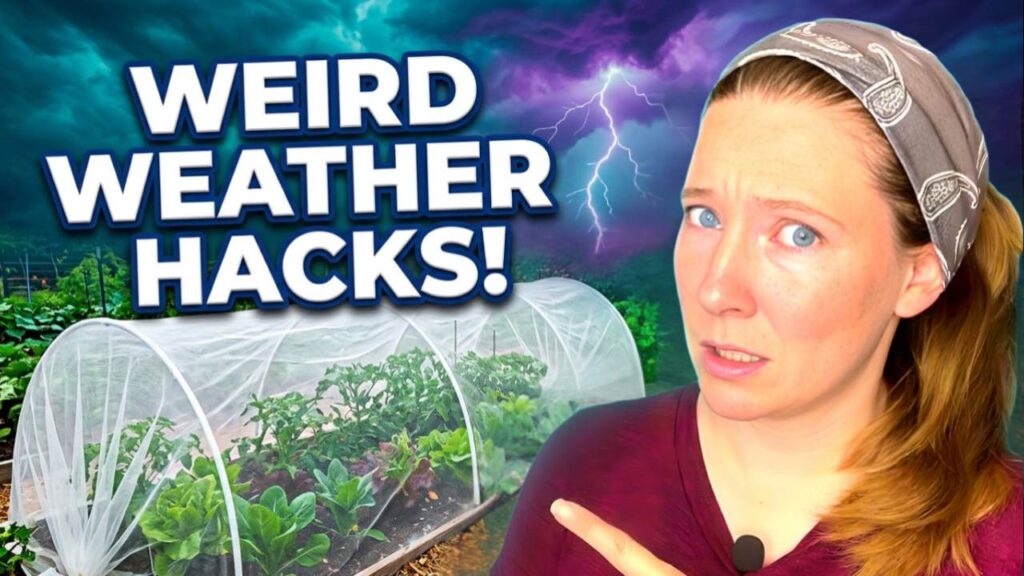
If you’ve noticed the weather getting weirder every year—longer droughts, surprise freezes, summers that feel like gardening on the sun—you’re not alone.
I’m not here to debate why it’s happening. What I do want to talk about is what we can actually DO about it without spending a fortune.
Because no matter what’s going on in the atmosphere, we still have seeds to plant and mouths to feed. And with grocery prices climbing every week, growing our own food has never been more important.
Today I’m sharing three affordable ways to protect your garden from extreme weather. These are the same strategies that saved my entire tomato crop during last year’s brutal drought.
Solution 1: The Sprinkler Hose for Drought
Raise your hand if you used to be a rain-dependent gardener.
For years, I watered deeply once a week and called it good. But as dry spells got longer and more intense, that just wasn’t cutting it anymore.
I tried drip irrigation in 2024. Set up the whole system. And honestly? I rarely used it. It’s very possible that’s a me problem, but I wasn’t in love with it.
What I DID fall in love with? The sprinkler hose.
No products found.
Not to Be Confused with a Soaker Hose
These are two very different things. A soaker hose weeps water directly into soil along its full length. A sprinkler hose has tiny holes that spray water out at a slight angle on two sides.
The streams are small, almost like a mist—think of that fine spray over lettuce at the grocery store. That’s essentially what you get.
Why I Love This Form of Irrigation So Much
First, the setup is ridiculously simple. You literally unroll it and connect it to a standard garden hose. No special fittings. If you can hook up a garden hose, you can use this.
Second, the cost. Compared to a full irrigation setup, these are very affordable.
Solution 2: Build a Simple Hoop Frame (It Handles Frost AND Heat)
Here’s the thing—the same basic infrastructure protects against both surprise frost events AND extreme heat. You just swap out what you drape over it.
By the way, if you want to scale up your gardening efforts this year and grow more of your family’s food, we have a FREE Staples Garden Printable that breaks down exactly what and how much to plant for a year’s worth of storage crops:
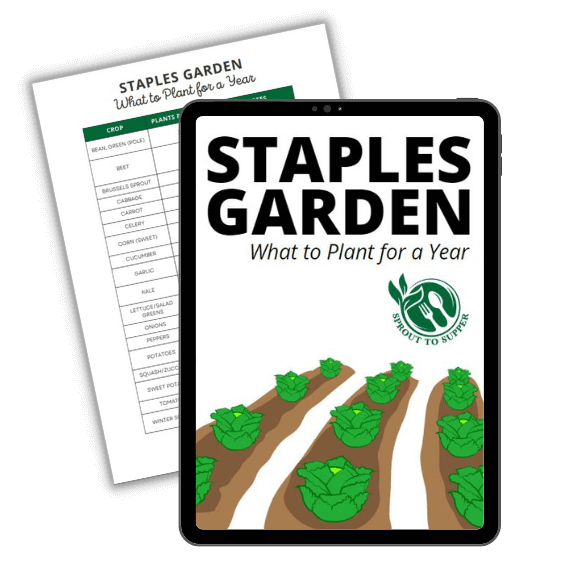
Dream of Filling Your Pantry with Homegrown Staples?
Plan your garden with our FREE PRINTABLE—Staples Garden: What to Plant to Feed Your Family for a Year!
What You Need
- Rebar – Short sections about 12 inches long
- Poly tubing – This is the black flexible irrigation tubing you’d use as a main line for drip irrigation. It bends easily and holds its shape. You can get a pretty big roll for less than 20 bucks.
No products found.
How to Set It Up
Take two pieces of rebar and push them into the ground on opposite sides of your row or raised bed. You can do this inside your raised bed or in the holes of cinder blocks if you’re using those. (That’s one reason I love this style bed—built-in holes for structure!)
Space these pairs every 2 feet down the length of your bed. Push them in just a few inches. They don’t need to be deep, just stable enough to hold the tubing.
Cut your poly tubing to the right length to arc across your bed. Slide each end over a piece of rebar, one on each side. The tubing is flexible, so it naturally forms that upside-down U shape.
Work your way down your bed, and you’ll have a tunnel frame in no time.
This frame is completely reusable. Pull it apart, store it during winter, and set it back up in minutes next season.
Solution 3: Frost Cloth for Cold Snaps
When a freeze is heading your way (and lately those come out of nowhere), just drape frost cloth or row cover fabric over the hoop frame.
Frost cloth is a lightweight, breathable fabric that traps warmth around your plants. More importantly, it prevents freezing dew from settling on the leaves.
Depending on the weight you choose, it can protect all the way down to the teens in Fahrenheit. Just drape it over, pin or clip the edges down. You can use bricks, clothespins, or anything to keep the wind from blowing it off.
No products found.
This is one of the cheapest insurance policies you can have for your garden. A roll of frost cloth is very affordable and reusable season after season.
Same Frame, Different Cover: Shade Cloth for Extreme Heat
Instead of a freeze, maybe you’re dealing with brutal heat. We’re talking days or weeks in the upper 90s to over 100 degrees with intense sun that scorches leaves and dries out beds fast.
Use the same hoop frame, just swap out your frost cloth for shade cloth.
Shade cloth is a woven mesh material that filters out a percentage of sunlight. You’ll see it rated as 30%, 40%, 50% shade, and so on. For most vegetables, 30% is a good starting point. I’ll have one linked below.
No products found.
Crops like lettuce, spinach, and other greens that bolt quickly in the heat benefit a lot from shade cloth. Even tomatoes and peppers, which love heat and sun, can struggle when temperatures get extreme and the UV is intense.
Shade cloth keeps the soil and air around plants just a few degrees cooler, which makes a real difference in yield and keeps plants from dropping their flowers. No flowers, no fruit—that’s the real problem.
Just drape it over the same hoop frame, secure the edges, and you’ve given your garden a fighting chance against summer heat.
None of these break the bank, and you may even have some materials lying around your property already.
The weather might be getting more unpredictable, but your garden doesn’t have to suffer for it. These simple, frugal solutions have saved my harvests more times than I can count.